What is the Wellness 2 Age program?
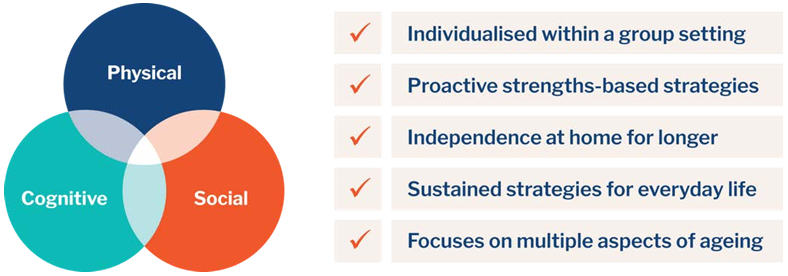
Wellness 2 Age is an innovative 10-week community-based program that focuses on multiple aspects of ageing by providing proactive strengths-based strategies that enable individuals over the age of 60 to maintain independence at home for longer and learn strategies for everyday life.
Over the period of the program, older people undertake a range of structured activities that focus on a holistic approach to targeting individual physical and cognitive challenges, while supporting social engagement needs. The program provides targeted activities that are graded to support individual needs, which are explicitly linked to home-based activities. These learned strategies can then easily translate into the older person’s everyday environment, ensuring that the program creates sustainable change for the older person, to enable wellness and independence.
Program outcomes include improved cognition, mobility, and social engagement for older people within the community.
Who is the program for?
Wellness 2 Age is targeted at older people who are motivated to remain living at home. They do not need to have had a specific diagnosis or injury to be involved or to undertake the program. For example, they may self-report finding it more difficult to do specific things, their balance may have deteriorated, or they may be finding it more difficult to get up and down stairs.
Conversely, if the individual has experienced an injury or received a diagnosis, this would not preclude them from taking part in the program. Even if the individual has been diagnosed with a condition such as Parkinsons disease, their eligibility for the program would still be explored.
Wellness 2 Age is not suitable for people that have severe cognitive impairment. As the participant will need to be able to follow instructions in completing the activities, you would be wanting to see them test in the mild to moderate range of cognitive impairment.
For older people who are motivated to remain living at home, Wellness 2 Age provides targeted and individualised strategies to build and maintain confidence in performing everyday tasks and activities, which enables older people to remain active and engaged within their communities.
For health professionals and care providers, Wellness 2 Age provides an opportunity to partner with older people in a new and holistic way to better support individual needs. This is achieved through targeted strategies that directly focus on keeping people independent and contributing to slowing the progression of chronic disease and disability, through an innovative and evidenced-based approach.
Who developed the Wellness 2 Age program?
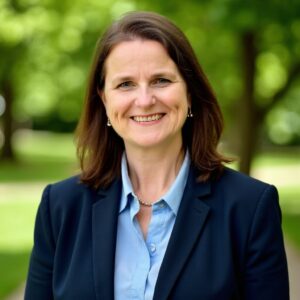
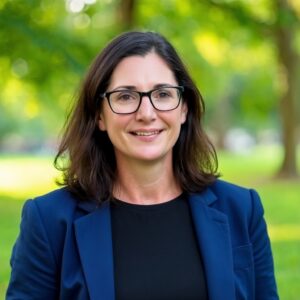
The Wellness 2 Age program was developed in Australia by Dr Kristy Robson, Senior Research Fellow and Associate Professor Melissa Nott, Principal Research Fellow, both from Charles Sturt University’s Three Rivers Department of Rural Health. Dr Robson and A/Professor Nott are registered Allied Health Professionals.
Kristy Robson
Melissa Nott
What is the evidence-base for the program’s effectiveness?
Ageing well: Pilot evaluation of a dual-task training program in a rural community
Summary
This pilot trial examined the feasibility and effectiveness of ‘Ageing Well’, a community-based program for improving cognitive skills and mobility of rural older people. The non-randomised, waitlist-controlled pilot trial was conducted at a regional NSW university clinic. 23 community-dwelling adults aged 60+ who had begun to experience a decline in their physical and/or cognitive abilities participated in the program. Participants engaged in dual-tasking activities that simultaneously challenged their motor and cognitive abilities. Student facilitators encouraged participants to progress through increasingly complex functional tasks in a range of contexts, including a café, supermarket and a simulated ‘home’. The Patient Reported Evaluation of Cognitive State (PRECiS) measured the impact of participant’s cognitive state in terms of how much they were ‘bothered’ by problems with their cognition. Functional mobility was measured by the Timed Up-and-Go (TUG), a test of static and dynamic balance, and the Six Minute Walk Test (6MWT). 75 community members requested to participate. Intervention participants’ PRECiS ratings in relation to impacts on their performance of everyday skills improved substantially, while the control group did not change (p=.04, ηp 2 =.18). Intervention participants walked 12% further in the 6MWT post intervention, while the control group distance did not change (p=.03, ηp2 =.22). TUG time was reduced by 1 second in the intervention group. There is strong interest in this dual-tasking program among older community-dwelling residents in this rural setting. The results of this pilot study support the feasibility and effectiveness of the Ageing Well program.
Aims
This pilot trial examined the feasibility and effectiveness of “Ageing Well,” a community-based program for improving cognitive skills and mobility of rural older people.
Outcomes
Intervention participants’ Patient Reported Evaluation of Cognitive State ratings in relation to impacts on their performance of everyday skills improved substantially, whereas the control group did not change. Intervention participants walked 12% further in the Six Minute Walk Test post-intervention, while the control group distance did not change. Timed Up-and-Go time was reduced by 1 second in the intervention group. There is a strong interest in this dual-tasking program among older community-dwelling residents in this rural setting. The results of this pilot study support the feasibility and effectiveness of the Ageing Well program
Citation
Nott, M., Robson, K., Murphy, K., Pope, R., Cuming, T., & Curtin, M. (2019). Ageing well: Pilot evaluation of a dual-task training program in a rural community. Australian Journal of Rural Health, 27(4), 311-316. https://doi.org/10.1111/ajr.12522
The Perceived Impact of the Intergenerational Component of an Ageing Well Program
Summary
This paper investigates the perceived impact of the intergenerational component of an Ageing Well Program from the perspectives of the older adult and university student participants. An interpretative phenomenological analysis approach was used, with data being collected via semi-structured interviews. Seven older adults and six students who participated in the most recent program were interviewed. “Forming Connections,” “Getting to Know the Older Adults” and “Assisting the Students Through the Learning Process” were the key themes that emerged from the data. Ultimately, it was perceived that the inclusion of an intergenerational component was of greater benefit to the university students.
Aims
The aim of this study was to investigate the impact of the intergenerational component of the Ageing Well Program from the perspectives of the older adult and university student participants.
Outcomes
Both the older adults and university students perceived that the intergenerational component of the Ageing Well Program had an impact upon them. The development of a connection between the two generations through the concept of intergenerational solidarity was of utmost importance to everyone involved. Communicating meaningfully and being relatable were two strategies that contributed to a student’s ability to connect with the older adults. Students who had previous experience working with older adults tended to be more successful in implementing these strategies. While many of the students had preconceived opinions about older adults prior to their participation in the program, getting to know them on a more personal level challenged these stereotypes and resulted in the students having a better understanding of the aging process. The older adults were able to assist the students throughout the learning process and helped them to recognize how they could adapt their treatment to accommodate for any difficulties associated with aging. From the perspective of the older adults, the incorporation of an intergenerational component within the Ageing Well Program was of greater benefit to the university students.
Citation
van der Veen, R., Robson, K., & Curtin, M. (2023). The Perceived Impact of the Intergenerational Component of an Ageing Well Program. Journal of Intergenerational Relationships, 1-16. https://doi.org/10.1080/15350770.2023.2272812
The perceived long-term impact of an ageing well program
Summary
A focus on healthy aging can enhance activity participation, and reduce the impact of chronic diseases and decline in function. Interpretive phenomenological analysis was used to explore the perspectives of nine participants of a university run Aging Well Program (AWP) 12 months following its completion. Analysis of the semi-structured interviews conducted, identified three key themes: 1) Using strategies to keep your mind alert; 2) I now know what to do to maintain my physical wellbeing; and 3) Connections with others. The findings indicated that the Ageing Well Program had long-term positive cognitive, physical and social impacts, from the perspectives of the participants.
Aims
the aim of this study was to investigate the impact of participating in the Ageing Well Program from the perspective of the participants, at least 12 months following the completion of the Program.
Outcomes
Participants of the Ageing Well Program spoke of the strategies they continued to implement 12 months following completion. The findings indicate that participants’ understanding of wellbeing and their own capacities increased, and they continued to implement physical and cognitive strategies over the long-term. When talking about cognitive strategies, participants discussed the importance of keeping mentally active, maintaining their memory, and being mindful, as beneficial strategies to continue to implement as they age. Additionally, they spoke of how their understanding on the benefits and ways to be physically active increased, including how to prevent and manage falls. An increase in social confidence, understanding and engagement was also identified by participants as a positive outcome of the group-based nature of the Ageing Well Program. These findings reflect the findings of other research, suggesting that strategies focusing on healthy aging were impactful when activities were tailored to each participant’s goals and capabilities. The outcomes further demonstrated the importance of the inclusion of meaningful activities for each individual to ensure activities are relevant to each participant and it can be applied to their real-life situations to facilitate ongoing use of strategies. In addition, the findings demonstrated that a focus on healthy aging can have long-term impacts on individuals, so an emphasis should be given to ensuring positions in such programs are allocated to new candidates rather than allowing previous candidates to repeat the program. However, despite the range of benefits of healthy aging, there is a paucity of literature that evaluates long-term outcomes and the perspectives of the participants. Further research evaluating these aspects is needed to enable effective healthy aging.
Citation
Timmermans, E., Robson, K., & Curtin, M. (2023). The perceived long-term impact of an ageing well program. Activities, Adaptation and Aging, 47(2), 113-132. https://doi.org/10.1080/01924788.2022.2028051
The Wellness 2 Age program has been found to be effective in increasing social confidence, memory, and physical function. Here’s some of the feedback received from program participants.
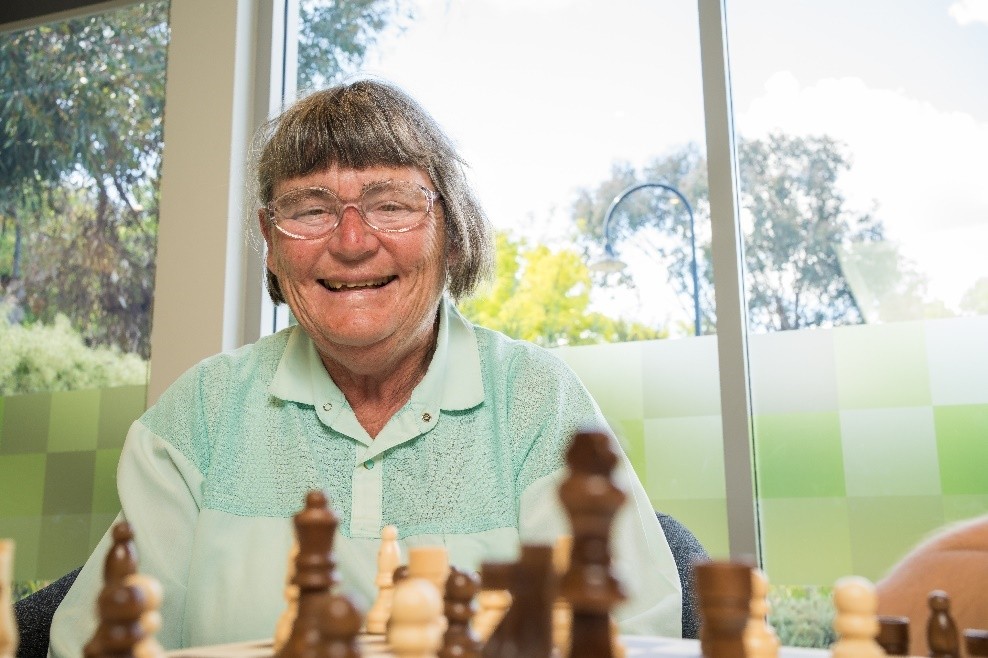
“It was good. Yeah, I had quite an improvement in mine. I think a lot about the balance stuff and I’ve been working on my balance for quite a while because I’ve had a lot of falls. I’d never thought about was I getting better. Then they timed me. I said, ‘Oh, I got significantly better.’” (Alice – participant)
“I would go to bed crying, and I’d wake up crying. Now, I go to bed with peace, and I wake up with a smile. It’s just giving me hope now, and I’m not gonna stop. I’m not stopping now ‘cause I thought I was doomed, and it looks like I’m not. These programs need to be run. They really, really do for the older seniors.” (Sophia – participant)
“With the program, mentally, it’s been fantastic for me. That’s the part that’s helped me the most, and the socialising. There was seven of you there today, staff and the girls, and to get out and about to fit in there and feel comfortable, and that’s all helped me greatly.” (George – participant)